
Submission on Management of Defence Estate Assets in Darwin, NT
By Friends of Lee Point – 17 April 2026
This submission for the Senate Inquiry into Management of Defence Estate Assets covers the two main defence estate sites in the Northern Territory plus a partially disused defence site at Lee Point.
Executive Summary
The proposed sale of significant disused defence land in Darwin will raise valuable funds for Defence. It also provides a unique opportunity to rectify a defence housing project problem at Lee Point.
In Darwin, the two main defence estate sites in the Senate inquiry are Defence Establishment Berrimah (123ha) and Kowandi North (362ha). Both sites are well located near existing infrastructure and public transport and have the potential to provide low-cost housing lots in support of affordable housing. To date, no heritage issues have been identified.
A third disused defence site, now partially developed, is at Lee Point. This site, owned by Defence Housing Australia (DHA), is not near existing infrastructure or public transport and has important natural and cultural heritage. DHA has only provided expensive lots and no affordable housing at Lee Point. The DHA Lee Point housing project is deeply unpopular with the Darwin community and strongly opposed by the Larrakia people (traditional owners of Darwin).
This submission proposes that the Defence Establishment Berrimah (DEB) site should be used for the DHA housing project instead of Lee Point.
It is also recommended that independent site evaluations are undertaken and published before the sale of disused defence sites and that they include public benefit assessments.
CONTENTS
1. Introduction
2. Lee Point case study
– Process for planning and development of the Lee Point defence estate asset
– Locating defence personnel at Lee Point
– Heritage significance of the Lee Point defence site
– Financial considerations
3. Land swap
4. Discussion
5. Summary
Appendix A – References
1.0 Introduction
Friends of Lee Point is a community-based organisation. Its main aim is to conserve the natural beauty and biodiversity of Lee Point.
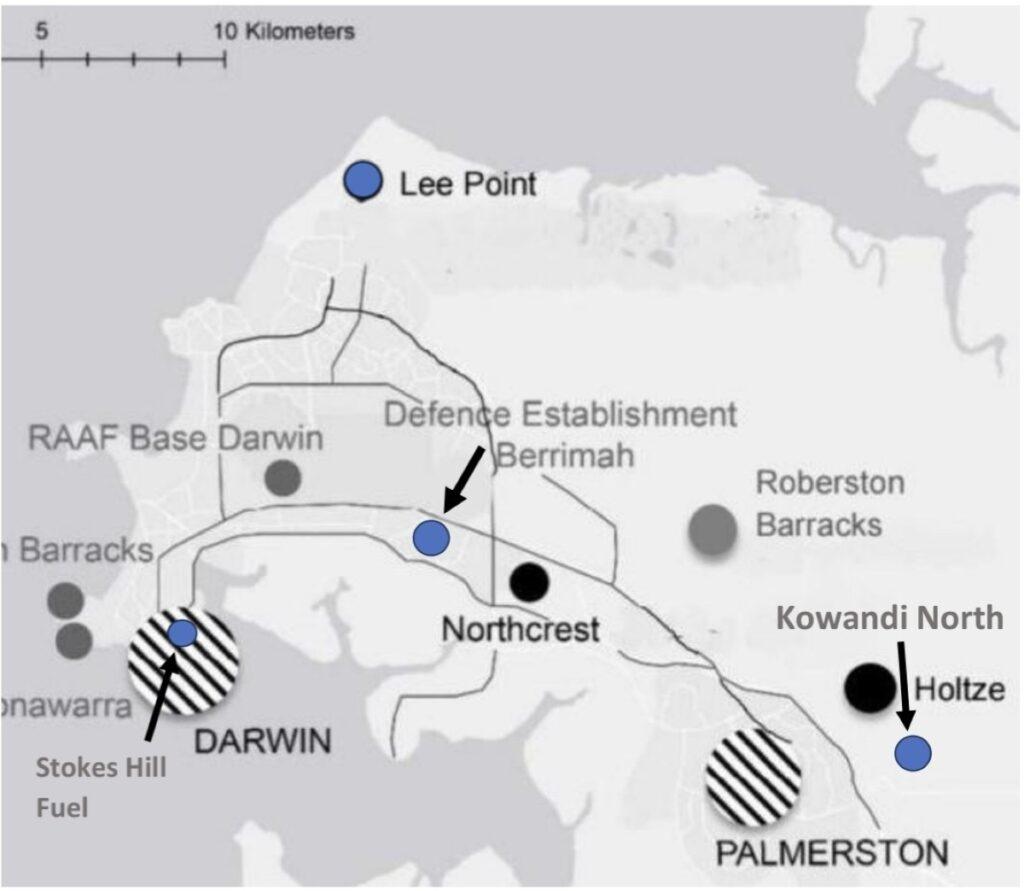
Fig 1. Map showing locations of the three defence estates and Lee Point; the main defence base is Roberston Barracks.
In Darwin, the three defence estate sites in the Senate Inquiry into Management of Defence Estate Assets are:
- Stokes Hill Fuel Installation – area 4 ha;
- Defence Establishment Berrimah (DEB) – area 123 ha; and
- Kowandi North – area 362 ha.
Given the small size of Stokes Hill Fuel Installation site (4 ha), it is not considered further in this submission The disused Lee Point defence site has been added for reasons outlined in this submission.
Currently, only a small portion (10-15%) of the disused Lee Point defence site has been developed. Defence Housing Australia (DHA) intends to develop the remainder of the site (~90 ha) for defence and community housing plus commercial purposes.
The Lee Point housing project has become deeply unpopular with the Darwin community and is strongly opposed by the traditional owners (REF 1).
2.0 Lee Point defence case study
This case study focusses on the planning process and assessments that led to the defence and community housing project at Lee Point. Approximately 70% of the lots at Lee Point are intended to be sold to private investors.
Process for planning and development of the Lee Point defence estate asset
DHA acquired the 2CRU Lee Point defence land from Defence in May 2014. The Area Plan* was created by DHA (a clear conflict of interest) in conjunction with the NT Government in 2014/15. The Environmental Impact Statement (EIS) was completed in 2018.
Prior to 2020, less than 15% of Darwin’s northern suburb population (most affected residents) were aware that thousands of people were going to be housed at Lee Point.
Clearing of Stage One occurred in Sept 2021 to the outrage of the Darwin community. In Oct 2021, City of Darwin called on the NT Government “…to place a moratorium on the current development of Muirhead North and Lee Point subdivision 2CRU until the Northern Territory Planning Commission has developed a comprehensive area plan for Lee Point that reflects the long-term wishes and needs of the community.”
Since then, numerous protests and legal challenges have occurred resulting in community members being arrested and fined, and delays to the project. Project delays included DHA being investigated and fined $18k for illegal land clearing.
The protests and legal challenges are ongoing and likely to attract further national media coverage.
Finding 1 – Extensive community consultations need to be carried out independently before land use decisions are made.
* The Territory Government has the primary responsibility for land use planning (Area Plans).
Locating defence personnel at Lee Point
Attracting and retaining defence personnel is essential for Defence. Greater consideration should have been given to locating defence personnel closer to the defence bases than Lee Point, particularly as other closer sites are available.
For example, the benefits of locating defence service personnel at Berrimah instead of Lee Point (REF 2) include:
Travel time – Defence personnel would save about 60-100 minutes each week driving to work from Berrimah instead of from Lee Point and would find it much easier to cycle to work (a healthier lifestyle) or use public transport. It would avoid time spent at the Vanderlin/Lee Point intersection (already a congested traffic area).
Cost of living – much better access to public transport helps reduce cost-of-living expenses. A second car may not be needed.
Health issues – it avoids problems with biting insects from tidal areas and offensive odours from the Leanyer sewage treatment ponds (REF 3).
Services and entertainment – there are a greater choice of established services and entertainment from the nearby CBDs of Darwin and Palmerston. A future benefit could be more vibrant CBDs through their greater use.
Finding 2 – Appropriate site selection has an important role to play in attracting and retaining defence personnel. Similar benefits would be achieved for non-defence people.
Heritage significance of the Lee Point defence site
Lee Point has important natural and cultural heritage for Darwin (REF 2).
Natural heritage – was largely ignored in the 2014/15 Area Planning process. An EIS completed in 2018 highlighted significant impacts on threatened species. The importance of the Lee Point old-growth forest and connected wildlife corridor became evident after the 2018 EIS. Additionally, no alternative site options have been investigated to avoid environmental offsets from the proposed clearing of endangered species habitat.
Cultural heritage – Consultation with the Larrakia traditional owners was found to be inadequate and has been a source of ongoing legal challenges. Larrakia people are strongly opposed to the project due to cultural reasons.
This deeply unpopular defence and community housing project has divided the Darwin community and created mistrust in the divestment process of disused defence sites, particularly where heritage is concerned.
Finding 3 – Comprehensive natural and cultural heritage assessments must be done prior to the sale of disused defence estates. Land clearing at Lee Point should cease immediately.
Financial considerations of the Lee Point site development
Approximately 70% of the Territory Government funding is provided by the Australian Government. Municipal and essential services do not appear to have been factored into the financial considerations when the Lee Point defence site was selected to house thousands of people (REF 2).
Roads – The traffic problems from housing at and near Lee Point are getting worse. Addressing this traffic congestion will be expensive and require Australian/NT Government funds (REF 4).
Sewage treatment – The treated sewage from the Leanyer sewage treatment pond facility overflows into Buffalo Creek. This creek is used by recreational fishermen. The sewage treatment ponds are at capacity and further upgrades to treatment capacity will be expensive.
Water and electricity – Lee Point is at the end of the Darwin water and electricity grid. Housing thousands of people at Lee Point means expanding the Darwin grid, an increase in capital and recurrent costs.
The DHA Lee Point housing project has the most expensive minimum lot cost of the major housing projects underway in Darwin (REF 5). It has not, nor is it expected to, produce any affordable housing (REF 6).
Finding 4 – housing projects should be located near jobs, frequent public transport and existing infrastructure to avoid expensive infrastructure upgrades.
3.0 Land swap
There are substantial problems associated with using the Lee Point site.
The sale of the DEB or Kowandi North site offers a unique opportunity to rectify the Lee Point housing problems. They are well located, near existing infrastructure and public transport and have potential to provide low-cost housing lots. To date, no heritage issues have been identified.
Friends of Lee Point have proposed to local MLAs that DEB be used instead of the Lee Point site for the defence housing project. Larrakia – Danggalabba traditional owners support the land swap (REF 7).
4.0 Discussion
Specific items are discussed below:
Planning – The planning for the Lee Point defence site occurred in the wrong order.
Prior to the land sale, information on natural and cultural heritage should be independently collected and published.
Area Planning also needs to be done independently. For the Lee Point defence site, the Lee Point Area Plan was created by the developer (DHA), a clear conflict of interest. The Lee Point Area Plan focussed on the needs of the developer, not the community.
Land swap – using the DEB site for the DHA housing project instead of Lee Point will:
- help conserve Lee Point – a special part of Darwin (REF 8) and respect the Larrakia people’s wishes (traditional owners of Darwin);
- accelerate the supply of low-cost lots (inclusionary zoning should be a consideration to encourage affordable housing);
- avoid increased capital and ongoing costs from a larger essential service infrastructure network;
- reduce travel costs from less car travel and better access to frequent public transport;
- improve Defence’s relationship with the Darwin community; and
- maximise public benefit.
A preliminary site evaluation for DEB is at (REF 9).
5.0 Summary
The following recommendations are made in relation to the management of defence estate sites in Darwin:
- Independent site evaluations include natural heritage, cultural heritage and public benefit, and these evaluations are undertaken and published before the sale of disused defence sites.
- DHA cease clearing works at Lee Point immediately, and
- the Defence Establishment Berrimah (DEB) site is used instead of Lee Point for the DHA housing project.
Appendix A
References
REF 1 Relocating and rescoping the Lee Point defence housing project – https://saveleepoint.org.au/april-relocating-rescoping-the-dha-housing-project/
REF 2 Planning for Lee Point – https://saveleepoint.org.au/planning-for-lee-point-darwin-nt/
REF 3 NT EPA (Sec 5) – https://ntepa.nt.gov.au/_resources/documents/eia/lee-point-urban-development/assessment_report_lee_point_urban_dev.PDF
REF 4 Traffic problems are getting worse – https://saveleepoint.org.au/feb-2026-traffic-problems-getting-worse/
REF 5 Alternative sites for defence housing – https://saveleepoint.org.au/feb-2026-alternative-sites-for-defence-housing/
REF 6 Independent housing report – https://saveleepoint.org.au/wp-content/uploads/2024/03/ATT-A-Lee-Point-DHA-independent-housing-report.pdf
REF 7 Build at Berrimah not Lee Point – https://saveleepoint.org.au/mar-30-defence-establishment-berrimah/
REF 8 Lee Point – a special part of Darwin – https://saveleepoint.org.au/lee-point-a-special-part-of-darwin-nt/
REF 9 Draft Report for 4 Darwin sites – https://saveleepoint.org.au/draft-report-for-4-darwin-sites-including-defence-establishment-berrimah-april-2026/