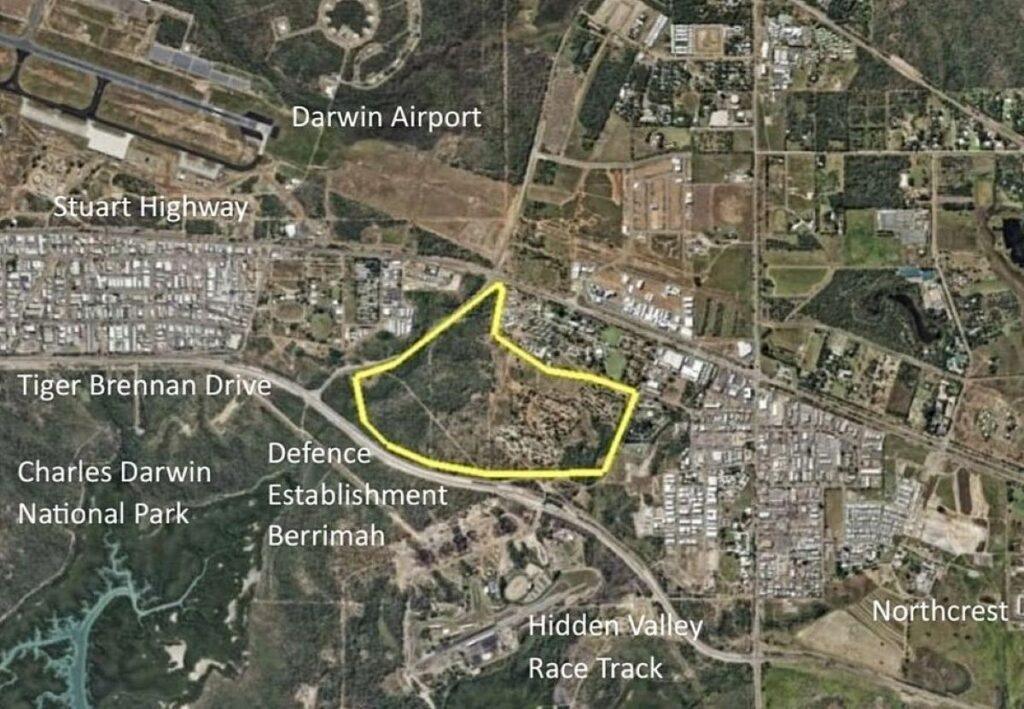
Fig 1. Site map of the (123ha) Defence Establishment Berrimah (DEB) site and surrounds – based on Google Maps
Preliminary evaluation summary
Friends of Lee Point and other community groups became aware in late March 2026 that the Defence Establishment Berrimah (DEB) site in Darwin was to be sold off.
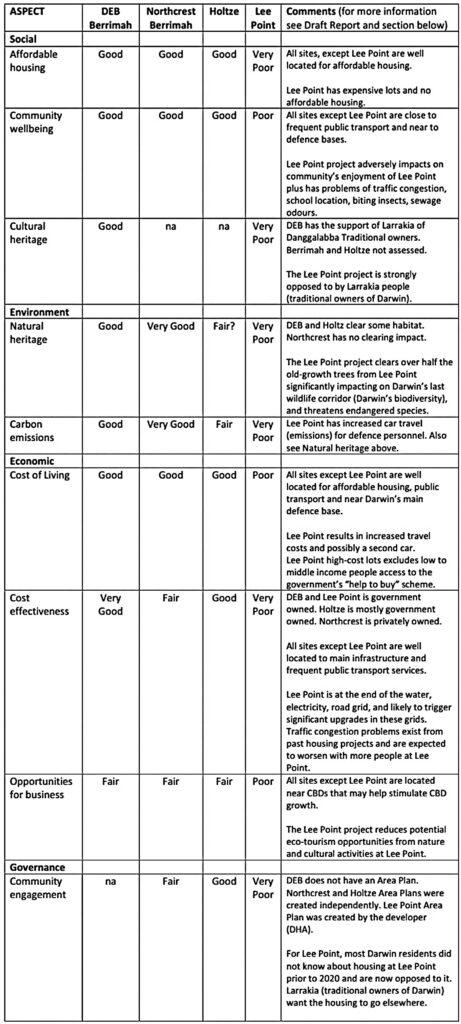
This preliminary evaluation indicates that the DEB site is the best site for the Defence Housing Australia (DHA) housing project currently located at Lee Point. The summary rating table below is a continuation from the Draft Report (3 Sites) published in July 2025.
Summary rating table – 4 Darwin sites for defence and community housing
Notes
-
All sites were visited, however, access to the Holtz and DEB sites were limited.
-
In total, (8) alternative locations were considered. The Defence owned Kowandi site at Holtz (also to be sold) was not evaluated, being the DEB site is more centrally located.
-
The unabridged Draft Report (3 Sites) is not on-line but is available on request.
-
Relocating and rescoping the Lee Point defence housing project is an overview of the Lee Point site problems.
Preliminary evaluation of the Defence Establishment Berrimah site
This section contains the evaluation methodology used for the 4 Darwin sites plus the Defence Establishment Berrimah (DEB) site evaluation.
Methodology for Evaluation
The evaluation for the 4 Darwin sites is broadly based on sustainability principles from Infrastructure Australia – government’s independent advisor on nationally significant infrastructure.
Sustainability refers to “meeting the needs of the present without compromising the ability of future generations to meet their own needs” and involves four components:
- social
- economic
- environmental
- governance
Rating these components can be an involved and complex task. Given the limited resources and time available, each component is broken into a small number of aspects and a simplistic rating system used. Each aspect is rated as:
- Very Good
- Good
- Fair
- Poor
- Very Poor
The rating of each aspect is based on the number of positive and negative points listed and associated comments. A rating with a question mark indicates a lack of information to make the rating.
Notes
-
Ratings could change with a more detailed and comprehensive evaluation.
-
Time and resources spent on collecting information has been prioritised to achieve a balanced and reasonable rating rather than to fully describe a problem or opportunity.
-
Infrastructure Australia prefers a Multi-criteria analysis (MCA), a system that weights and rates many aspects to provide a comprehensive evaluation of different project options.
Site Evaluation
The site evaluation uses four components:
- Social
- Environmental
- Economic
- Governance
1.0 SOCIAL
Infrastructure Australia consider social outcomes relate to, but are not limited to, improving community health, liveability and wellbeing, social cohesion, gender equality, education, housing, and security.
To simplify the evaluation of social outcomes, three aspects were selected:
- affordable housing
- community wellbeing
- cultural heritage
Affordable housing
Site Rating – potential to create well located homes under $600k.
“Well located” under the National Housing Accord for the NT is defined as: housing that provides reasonable access to education, employment, essential services, transport, and/or infrastructure, as relevant to the regional and community context. Ref National Housing Accord schedules.
The Australian Government’s “Help to buy” scheme is set at $600k or less for Darwin. A basic Darwin house is worth ~$400k. This requires a lot to cost less than $200k to have house/land under $600k.
Infrastructure for all the lots e.g. roads, drainage, water, sewerage, and electricity are provided by the developer. In DHA’s case, it retains up to 30% of the lots for defence housing.
DEB – Affordable housing – GOOD
Positive
- Well located for public transport and other services
Negative – Nil
Comment
- Has potential to create low-cost lots for affordable housing
- Holtz has created some lots under $200k.
Community wellbeing
Site Rating – potential to add to community wellbeing.
DEB – Wellbeing – GOOD
Positive
- Close to public transport
- Cycling options – defence bases, Darwin CBD, Palmerston CBD, Charles Darwin National Park
- Cost of living – refer Economic section
Negative – see comments below
Comment
- Noise from Tiger Brennan Drive or Hidden Valley Drag Strip is not listed as a negative because buffers are expected to be included in the Area Plan.
- The Hidden Valley Drag Strip is over a kilometre away from most of the DEB site and located in a valley (helps reduce noise). The south-eastern corner of DEB site is the most exposed area to Drag Strip noise.
- It has been assumed that approx. 80% of the 123ha site (~100ha), will be used for housing, and the remainder for conservation or other purposes.
Cultural Heritage
Site Rating – potential to maintain or meet the cultural needs of the Darwin traditional owners (Larrakia) for future generations.
Aboriginal cultural heritage is deeply connected to the land and sea. It contains tangible elements like artifacts and sites and intangible aspects such as stories, songs, and ceremonies.
“Free, Prior and Informed Consent” (FPIC) is a specific right for indigenous people that was adopted by the United Nations in 2007 as a crucial aspect of sustainable development. In maintaining or meeting the cultural needs of the Larrakia people it would be expected that FPIC would be sought prior to any development commencing.
DEB – Cultural Heritage – GOOD
Positive
- Supported by Larrakia – Danggalabba Traditional owners
Negative – NIL
Comment
- Defence assessed site as having – NIL History or Heritage concerns.
2.0 ENVIRONMENTAL
Infrastructure Australia consider environmental outcomes are related to, but not limited to, impacts on our atmosphere, land, oceans, seas, habitat, coasts, freshwater and biodiversity due to factors such as carbon emissions, use of natural resources, toxic materials, efficient use of resources, waste management and reforestation.
To simplify the evaluation of environmental outcomes, two aspects were selected:
- natural heritage
- carbon emissions
Natural Heritage
Site Rating – potential for ecologically sustainable development.
The Top End’s tropical savannas are globally significant – most of Kakadu National Park is made up of tropical savannas. The savannas are now in trouble, refer The State and Future of the Territory’s savannas, June 2025.
Many species, particularly mammals, that were once common and widespread, have disappeared from much of the Top End.
The Greater Darwin savannas have not been affected by the Gamba and Buffel Grass fires to the same extent as other Top End locations. Fringes of Darwin now contain some of the most biodiverse habitat left for native mammals in the Top End. It has been identified as being an important refuge for endangered species Ref ABC article – Aug 2023.
The Darwin refuge areas that are most valuable to mammals are the ones connected to the rural area. This is because some mammals need large areas for their survival e.g. endangered Black-footed Tree-Rat.
Berrimah has no connection to the rural area. Holtze’s connection is still to be determined by area planning. Lee Point is part of the last Darwin Wildlife Corridor, connected savanna habitat that runs across the north of Darwin to the rural area.
DEB – Natural Heritage – GOOD
Positives
- Majority of the area has been previously cleared
- Potential to improve the site with natural planting
Negatives – NIL
Comment
- Site has no connection to the rural area i.e. not suitable for a refuge for certain mammals.
- Separated from Charles Darwin National Park by a major 4 lane road.
Carbon emissions
Site Rating – potential for mitigating emissions from a major housing development.
DEB – Carbon emissions – VERY GOOD
Positive
- reduced travel emissions, near to defence bases with cycling being an option
- close to public transport
- majority of the area has been previously cleared
Negative – NIL
3.0 ECONOMIC
Infrastructure Australia consider economic outcomes relate to, but are not limited to, productivity, employment, financial stability, consumption, production, innovation, wealth creation, international competitiveness, social mobility, and value for money.
To simplify the evaluation of economic outcomes, three aspects were selected:
- cost of living
- cost effectiveness
- opportunities for business
Cost of Living
Site Rating – opportunity to reduce individual’s cost of living.
DEB – Cost of Living – GOOD
Positive
- frequent public transport
- central location reduces transport costs
- well located for affordable housing
Negative – NIL
Comment
- Has potential to create low-cost lots for affordable housing
- Expected to half fuel costs for defence personnel compared to Lee Point
Cost effectiveness
Site Rating – optimising tax-payer infrastructure expenditure on capital and ongoing items while facilitating affordable dwelling supply.
DEB – Infrastructure cost effectiveness – VERY GOOD
Positive
- Adjacent to major water, electricity, and transport infrastructure running to Darwin City
- Land is owned by Australian Government
Negative
- NIL
Comment
- Southwestern corner is low lying and may not be suitable for development
Opportunities for business (wealth creation, innovation)
Site Rating – opportunity to grow business in Darwin.
Tourism is an important part of Darwin’s economy. A survey undertaken in 2022 found that 90% of travelers are looking for sustainable travel options and 50% were prepared to pay more for these options, refer Sustainable Tourism.
DEB – Opportunities for business – FAIR
Positive
- Should help invigorate Darwin and Palmerston CBD
Negative – NIL
4.0 GOVERNANCE
Infrastructure Australia consider governance outcomes are related to, but not limited to, inclusive governance mechanisms, effective community engagement, capacity building, transparency, and user focus.
To simplify the evaluation of governance outcomes, one aspect was selected:
- community engagement
Community engagement
Site Rating – how well the Area Plan reflects community long-term needs and wishes.
DEB – Community engagement – not available
Comment
- DEB site does not have an Area Plan.
- There is a Senate inquiry on the Management of Defence Estate Assets underway – submissions close 17 April 2026. This is probably the first community engagement for the DEB site.
- The site has been used for temporary accommodation in the past.